*Featured in The University of Miami’s “The Scientifica”*
There is a good chance that you woke up today and looked at your phone, hoping to see notifications from Instagram, Snapchat, Facebook, and other social media platforms. Don’t worry; it is not your fault. Rather, it is an instinct to check your phone first thing in the morning, as you are interested in seeing other people’s opinions, requests, and advertising. You then get out of bed, get ready, and as you are walking to class, you decide to check your Instagram to see how many likes your selfie got.
Unfortunately, you did not receive as many likes as you wanted; how does that make you feel? Do you want to delete the picture to prevent other people from judging how many likes your post got? You decide to figure it out later and arrive at your class. A few minutes before class starts, you check your Snapchat to see your recent contacts. Why hasn’t anyone responded to me all day? You put your phone down as the class starts, knowing that you will be picking it up at the very minute the class ends to click through these platforms again.
As a college student, this is how I check my phone throughout the day. These thoughts flow not only through my head but from people all around the world. Why do we have these negative feelings when we don’t get likes on Instagram pictures or when no one responds to our Snapchat? Why do we feel ecstatic and confident when we receive a lot of engagement on a Facebook post? This is because there is a great number of psychological thought processes that dictate how a user interacts and thinks about social media. Students at the University of Miami are no different, and upon interviewing many and comparing their experiences to that of documented scientific literature, I found many parallels.
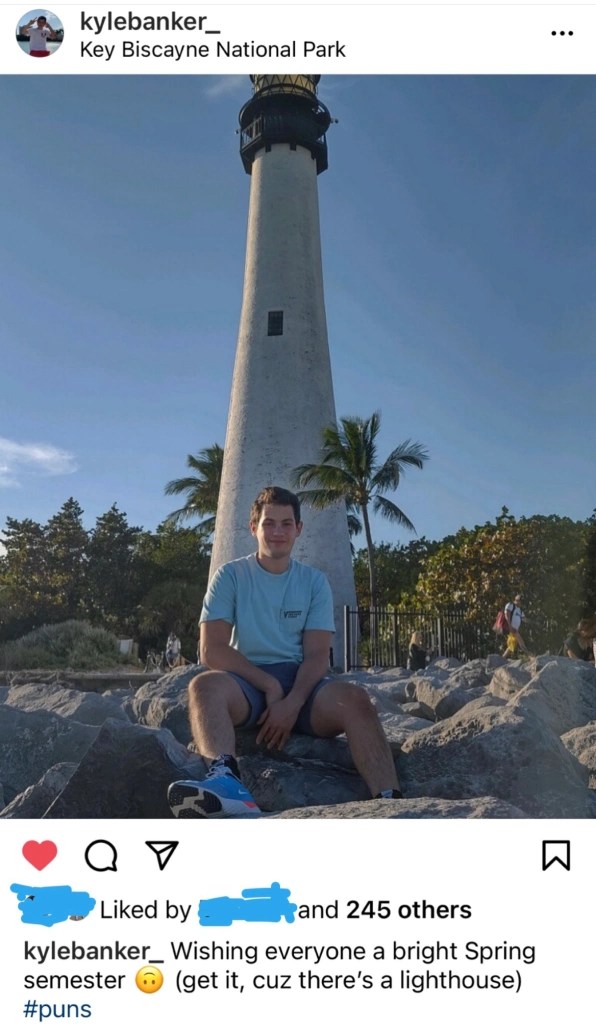
First, let’s dive into the concept of ‘likes’ and how individuals value them. Likes on social media platforms such as Instagram, Facebook, and Twitter represent how many people click a button on your post to show their enjoyment of your content. However, this system is not always uplifting and can go either way. Say you have 400 followers on Instagram when you post a picture, and four hours later, the picture gets 700 likes. How would you feel once seeing the high like count? It should make you feel good due to a rush of dopamine based on the received positive feedback.
A study conducted in 2016 with 32 teenagers showed that when the subjects saw their photos with a large number of likes, there was activity across a wide variety of regions in the brain, mostly including the nucleus accumbens. The reason why the reward pathway in our brain “lights up” when we see our achievement is that we want to give off the best impressions to people who view our page for the first time. In the same study mentioned above, the teenagers were also shown “neutral” photos, including pictures of food, friends, and other normal things. The researchers found that no matter what the picture was, the teenagers were more likely to like the post that already had a substantial amount of likes. So, if your posts are doing “well” to your standards, then you should be feeling good. However, social media is all about judgment, and unfortunately, things do not always go your way.
If your posts do not receive much engagement, then your feelings can go south very quickly. Instead of transmitting high levels of dopamine with high likes, your dopamine levels will drop, which ultimately makes people less likely to achieve a goal. For example, you plan to go on a run around the neighborhood, and you check and see that your most recent Tweet did not receive as many likes as you hoped. Will you still be as motivated to go on that run as before? Probably not.
All of these mind games come down to how much you value social media. If you believe that other people’s opinions are facts, then your esteem and confidence will be low, and you will consistently seek approval. So, if you are going to use social media platforms like Instagram and Facebook, you need to come to terms with the fact that you cannot control how many likes you get.
I also believe that the idea of a ‘follower count’ leads to stress for social media users. Why do people care so much about their follower count? Because you may be judged by others if you have a low follower count. In the end, social media should not be used to compare followings but rather as a tool for aspiration and positivity.
Stephen Buckley, an expert from Mental Health Charity Mind, states that “while low self-esteem isn’t in itself a mental health problem, the two are closely linked. Low self-esteem could, in turn, contribute to depression or other mental health problems, so it is vital to use social media safely and recognize when it might be harming your mental health.” No matter if it is about likes or followers, the best thing you can do to maintain your mental health is to focus on yourself and not others because social media is all about what you want to share and not what others may push you to do.
I decided to get an even deeper understanding of how social media is used by teenagers and young adults. To do so, I released a Google Form to students at the University of Miami to see how they approach and think about social media platforms. In total, I received responses from 86 students. To break down the student demographic, most of the respondents were sophomores and juniors, 62% of the respondents were male and 35% of the respondents were female. Most of the students, about 66%, only post on social media every once in a while, and 41% picked Instagram as their favorite social media platform.
Of these respondents, almost half use social media for 1-3 hours daily, and the greater majority use it for 3-5 hours daily. When asked how they would feel if one of their posts did not get over a hundred likes or comments, 50% of respondents said they would not care, and 48% said that it would bother them, but it would not be a big deal. The students were also asked whether they care about their follower count or not; about two-thirds of the respondents said that followers do not matter to them. Finally, they were asked whether they believe that social media has an overall positive or negative effect on their mental health; 35% said that it has a positive effect while 64% feels like it has a negative effect.
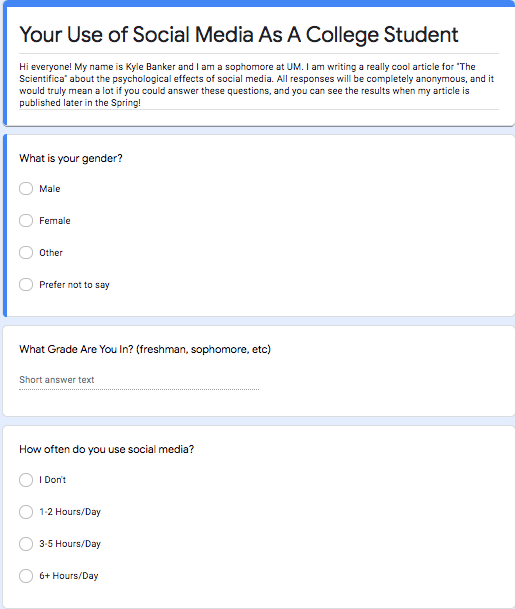
Throughout the data collection process, I was asked a lot about the purpose of the survey. I was looking for three things: if UM students care about likes, followers, and whether or not they believe that social media is beneficial for your brain. While I was not able to interview every single student at the University of Miami, I stuck with a smaller sample size while still maintaining as much diversity as possible (age, major, gender, etc). I find the data about the daily usage of social media to be unsurprising, as I expected most students to use social media for around 3-5 hours a day.
As all social media users know, it is easy to spend a great amount of time looking at Instagram pictures or answering Snapchats. The survey also shows that the respondents do not put a lot of time into caring about their followers and likes. As someone who does so myself, I am happy that others are not afraid to be judged by the general public based on pure numbers on their social media pages.
However, the data point that I find the most important, and what I would like to end on, is the way the University of Miami students view social media in terms of their mental health. There was an overwhelming majority that agreed that social media has a negative impact. This makes sense. The negatives arise through instances such as the anxiety of posting and hoping that you get hundreds of likes and being compared to other people based on follower counts. There are so many small actions and events that can cause platforms like Instagram, Snapchat, and Facebook to be stressful, number-based, and sometimes not even enjoyable.
In the end, I find it most important to have fun and be free on social media, but in today’s society, that does not seem to be the case. While there are positive aspects to social media, such as seeing your friends’ content or getting a ton of engagement, many of the respondents may see that the countless cons can significantly outweigh the few positives.
In conclusion, social media has its ups and downs, but it completely depends on how you view and use certain platforms. The psychological effects of these platforms show that even the smallest actions, such as someone double-tapping your post, can send waves of excitement through your head. However, when you face the downsides of social media, it can lead to instances of sadness and a lack of motivation. Posting on Instagram, Snapchat, Facebook, Twitter, and other platforms is all in your control, but the external factors from engagement are not controllable. Be careful with how you use social media because while it can be amazing and show how awesome of a person you are, it also has the potential to make you feel vulnerable and down if your posts do not perform the way you had hoped.

 Kyle Banker