Once reserved for the ultra-rich, virtual reality (VR) has become very common and apparent, with entertainment stations featuring VR equipment in many malls, movie theaters, and arcades. According to Statista, the market size for both virtual reality and augmented reality expects to hit $296.9 billion in 2024. With such a large market potential, it is important to recognize and understand the rise of virtual reality and its impact on the scientific world.
VR is defined as the computer technology that creates a simulated environment and is differentiated from augmented reality (AR) in that the latter features a superimposed perspective based on the user’s view of the real world. Examples of AR include Pokemon Go and Snapchat lenses, while VR requires the user to enter a much different environment. To enter this environment, users will put on a head-mounted display (HMD), a large box that goes in front of the eyes and acts as eyeglasses. An HMD can stimulate many senses, including vision, hearing, touch, and smell. As a result, VR inserts the user into a completely different environment where they can become completely detached from their surroundings.
With over 171 million virtual reality users worldwide, there are many competing brands for consumers. The most popular company is Oculus: a VR hardware business founded in 2012 in California. In 2014, Facebook (now known as Meta) purchased Oculus and sold an estimated 7 million units in 2021. Oculus has become notable for pushing out frequent updates and upgrades. One of these examples is the famed Oculus Quest 2, which it has recently released.
Compared to the original Quest unit, Oculus altered the head strap to the HMD to make it more comfortable, created a better-resolution image, increased storage capacity, and added a larger selection of titles. However, the Oculus Quest 2 is not just limited to gaming. Instead, users can “sit in front at a live concert” or “burn calories atop a glacier,” showing that the Oculus product is versatile. All these accessories add to the popularity of virtual reality and push other companies to provide superior services to their customers.
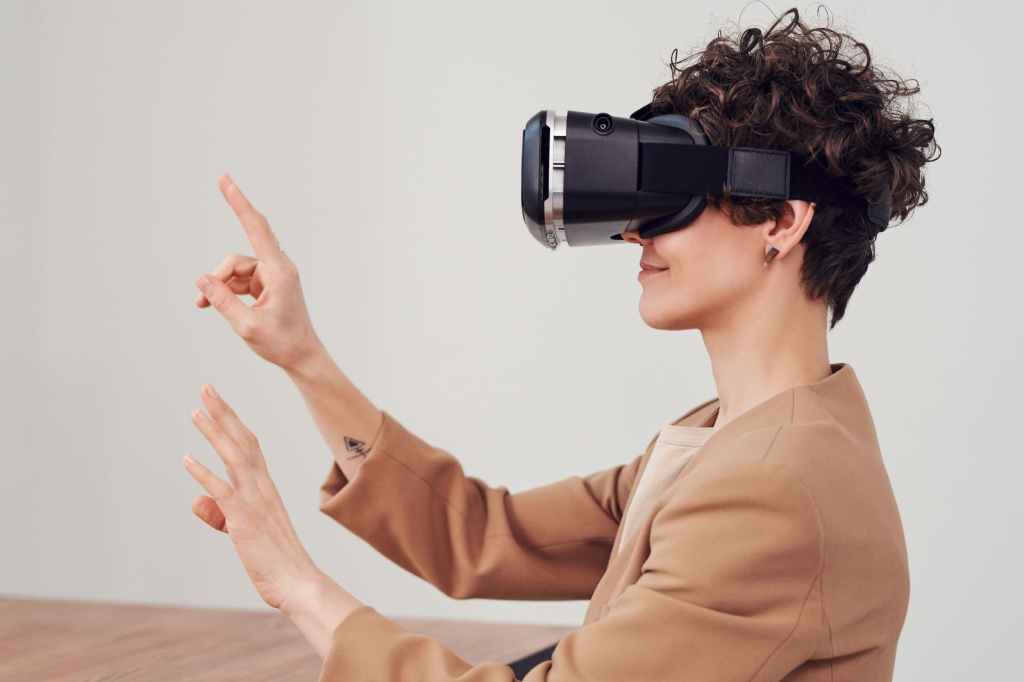
Other companies participating in creating this pixelated world include Samsung, Microsoft, Nvidia, AMD, Google, and many more. Each of these companies offers varying styles of headsets and accessories, which allows the consumer to make a personalized choice based on their desires. Fascinatingly, one of Google’s virtual reality platforms is based on a cardboard box.
Google Cardboard is Google’s initiative to have customers experience virtual reality in a simple, fun, and affordable way. To join the inexpensive fun, you can look up Google Cardboard online and buy a viewer (or HMD) starting at only $8.95. Afterward, you attach your phone to the viewer and can install free apps from the Google Play Store to use. When comparing virtual reality products like Oculus and Google, it is interesting to see how vastly they can differ yet offer similar products. Whether you prefer a certain price or style, you will absolutely be able to pick the VR product that is perfect for you.
A common question asked about virtual reality involves its neurological effect on humans. How does virtual reality provoke us to act differently? When you put on the headset, you are in an entirely new environment that can activate senses like vision, hearing, and possibly scent. The stimulation of all these senses is critical to becoming completely immersed in the virtual world. Vision and hearing are mandatory for a complete VR experience, as any intrusion from the external world can interrupt the immersion. Overall, creating these simulated environments similar to the real world can be deceiving and “trick” your brain into thinking that you are actually in the pixelated world.

Virtual reality primarily targets the hippocampus, an area of the brain responsible for navigation. The hippocampus heavily relies on inputs that give you information about your location and direction. Based on this information, you decide where to go or what to do while in the simulated environment. Science shows that virtual reality ultimately does confuse the brain. VR causes about 60% of the neurons in the hippocampus to shut down, according to an experiment run by researchers on rats at the University of California. This decrease in neuronal activity can significantly affect human decision-making and behavior, which is why we tend to act differently in virtual environments compared to real environments. In summary, while virtual reality may provoke the brain to learn the surrounding area and activate some neurons, our brains cannot form a mental map, which is an obligatory component of learning and memorizing.
Virtual reality has become a powerful tool in brain research as researchers can now immerse subjects in simulated situations to assess their decision-making and behavior. However, we are unsure whether this technology is ultimately beneficial or harmful. Conflicting studies about virtual reality’s positive and negative health effects are still being published. Due to the recent emergence of these products, researchers are still testing and learning more daily. With the Metaverse becoming a hot topic, virtual reality will hopefully continue to grow. It will be interesting to see how the industry transforms in the next few decades as we continue to make advances in science and technology.
Sources
Bardi, J. (2019). What is Virtual Reality? [Definition and Examples]. Retrieved 18 March 2022, from https://www.marxentlabs.com/what-is-virtual-reality/
Can Virtual Reality cause brain damage? – ServReality. (2022). Retrieved 18 March 2022, from https://servreality.com/blog/can-virtual-reality-cause-brain-damage/#:~:text=The%20scientists%20record%20the%20signals,formation%20of%20the%20mental%20map.
Get Cardboard – Google VR. (2022). Retrieved 18 March 2022, from https://arvr.google.com/cardboard/get-cardboard/
Hall, K. (2022). A cognitive psychologist explains how immersive technologies are improving the human experience. 3M in the United States. Retrieved March 18, 2022, from https://www.3m.com/3M/en_US/particles/all-articles/article-detail/~/virtual-vs-augmented-reality-glasses-headset-medical-uses/?storyid=7ad6bb5d-0ac4-4a76-a4ac-aa052734a437#:~:text=Virtual%20reality’s%20positive%20influence%20on%20your%20brain&text=%E2%80%9CIt%20makes%20your%20brain%20believe,and%20senses%20respond%20to%20them.
Knight, S. (2022). Oculus device sales estimated at nearly 7M units in 2021. Retrieved 18 March 2022, from https://www.techspot.com/news/92833-oculus-device-sales-estimated-nearly-7m-units-2021.html#:~:text=Oculus%20device%20sales%20estimated%20at%20nearly%207M%20units%20in%202021%20%7C%20TechSpot
Oculus Compare Headsets | VR Systems Compared | Oculus. (2022). Retrieved 18 March 2022, from https://www.oculus.com/compare/
Oculus Quest 2: Our Most Advanced New All-in-One VR Headset | Oculus. (2022). Retrieved 18 March 2022, from https://www.oculus.com/quest-2/
Virtual reality changes your brain . (2019). Retrieved 18 March 2022, from https://www.verizon.com/about/our-company/fourth-industrial-revolution/virtual-reality-changes-your-brain
10 Virtual Reality Statistics You Should Know in 2022 [Infographic]. (2022). Retrieved 18 March 2022, from https://www.oberlo.com/blog/virtual-reality-statistics#:~:text=14.94%20million%20units%20of%20AR,2020%20(eMarketer%2C%202020).
45 Virtual Reality Statistics That Will Rock the Market in 2022. (2022). Retrieved 18 March 2022, from https://techjury.net/blog/virtual-reality-statistics/#gref

 Kyle Banker